
RESPIRATORY CONDITIONS
Air Leak & Pneumothorax
A practical guide for paediatric registrars · Pneumothorax, pneumomediastinum, PIE and pneumopericardium in the newborn
SUSPECT TENSION
PNEUMOTHORAX
Alveolar over-distension & rupture
High or uneven transpulmonary pressure over-distends and ruptures alveoli. The starting point of every air leak.
Air dissects into the interstitium (PIE)
Air tracks along the perivascular and peribronchial sheaths, giving a bubbly/streaky lung.
Extra-alveolar air collections
Air reaches the mediastinum (pneumomediastinum), pleural space (pneumothorax) or pericardium (pneumopericardium).
Tension physiology
A one-way valve lets air accumulate under pressure → lung collapse, mediastinal shift and impaired venous return.
Impaired gas exchange & circulation
Collapse and shift cause hypoxaemia and hypercapnia; under tension, falling cardiac output and shock.
CLINICAL FINDINGS
- Sudden deterioration: desaturation, bradycardia, hypotension (tension)
- Increased work of breathing and cyanosis
- Asymmetric chest movement; reduced air entry and hyper-resonance on the affected side
- Shifted apex beat / heart sounds (mediastinal shift); distended abdomen
- In a ventilated baby: sudden rise in oxygen/ventilation needs, falling compliance
- Pneumomediastinum: muffled heart sounds, often less dramatic
INVESTIGATIONS
- CXR confirms: lucent hemithorax, absent lung markings, visible lung edge, mediastinal shift
- "Spinnaker sail"/uplifted thymus in pneumomediastinum; bubbly/cystic PIE
- Transillumination - bright on the affected side; a fast bedside aid in an unstable baby (not definitive)
- Blood gas: hypoxaemia, hypercapnia
- Continuous pre/post-ductal SpO₂
- In peri-arrest tension, do NOT wait for a CXR - decompress clinically
COMPLICATIONS & RED FLAGS
- Tension pneumothorax → cardiorespiratory collapse (emergency)
- Pneumopericardium → cardiac tamponade (rare, life-threatening)
- Associated PPHN and IVH (from pressure swings)
- Red flag: sudden desaturation + bradycardia + hypotension in a ventilated baby = tension until proven otherwise
- Asymmetric chest with mediastinal shift - act, don't wait
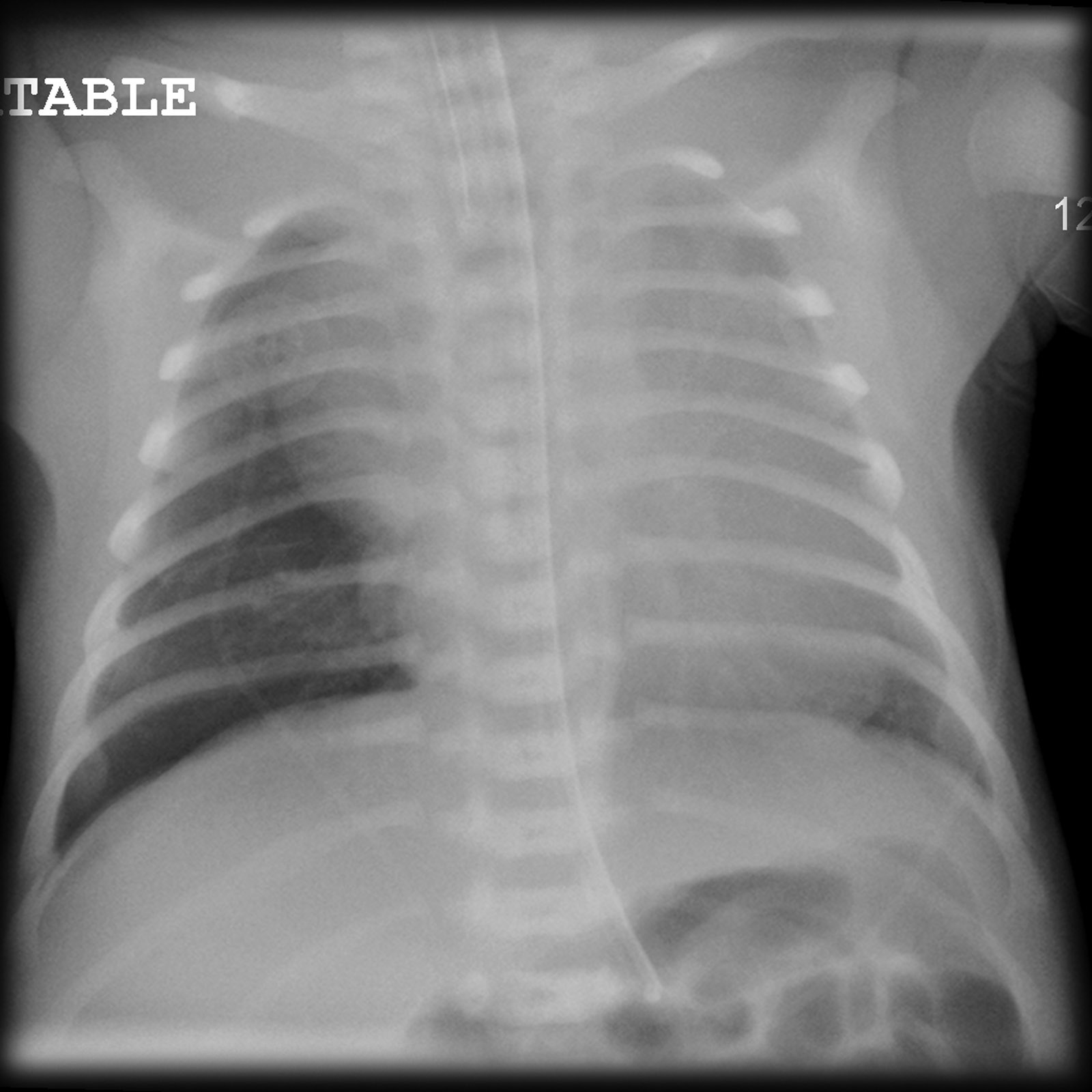
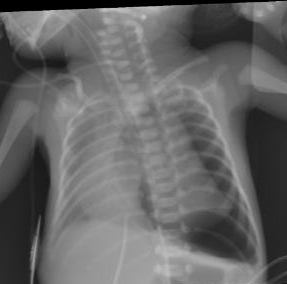
Pneumothorax: a lucent hemithorax with absent lung markings, a visible lung edge and mediastinal shift away from the affected side (deep sulcus sign on a supine film). Pneumomediastinum lifts the thymus ("spinnaker sail" sign); PIE gives a bubbly/cystic lung. In a collapsing baby, decompress on clinical grounds - don't wait for the film.
Pneumothorax: Case courtesy of Angela Byrne, Radiopaedia.org. From the case rID: 7589. CC BY-NC-SA 3.0
Tension: Case courtesy of The Radswiki, Radiopaedia.org. From the case rID: 11801. CC BY-NC-SA 3.0
MANAGEMENT
Match the response to the severity - observe the small and stable, decompress the symptomatic, and never delay for imaging in a tension.
Small / Asymptomatic
- Small, asymptomatic pneumothorax in a stable, non-ventilated infant: observe with supportive care and serial monitoring
- Most resolve spontaneously
- High-FiO₂ "nitrogen washout" is no longer recommended (hyperoxia risk)
Symptomatic - Drainage
- Tension/emergency: needle thoracocentesis/aspiration without waiting for imaging
- Definitive: intercostal catheter (chest drain) to underwater seal ± suction
- Pneumomediastinum is usually managed conservatively
- Pneumopericardium with tamponade only: pericardiocentesis is rarely needed and is a dangerous, last-resort emergency - reserved for confirmed cardiac tamponade and performed by experienced senior staff (ideally two consultants). It is not routine; do not confuse a pneumopericardium with a (usually benign) pneumomediastinum.
Prevent & Support
- Lung-protective ventilation: lowest effective pressures, volume-targeted, permissive hypercapnia
- HFOV for severe PIE or air leak
- Treat underlying disease (surfactant for RDS); analgesia
- Maintain oxygenation and perfusion; call NETS for instability or retrieval
- Watch for sudden deterioration - desaturation, bradycardia, asymmetric chest movement or shift (tension).
- Keep a chest-drain / needle-decompression kit accessible; assist with transillumination.
- Post-drain care: monitor swing and bubbling, the dressing and the site; document output.
- Continuous SpO2 and work-of-breathing monitoring.
How do you recognise and immediately manage a tension pneumothorax when there's no time for a CXR?
What is the role - and the limitation - of transillumination at the bedside?
When is a pneumothorax safe to observe versus drain?
How does lung-protective ventilation reduce air-leak risk?
Take-home message: Air leak is extra-alveolar air from alveolar over-distension and rupture - most importantly pneumothorax. Suspect a tension pneumothorax in any ventilated baby who suddenly desaturates with bradycardia and hypotension, and decompress on clinical grounds without waiting for a CXR. Small, asymptomatic leaks can be observed; symptomatic or tension leaks need needle decompression then a chest drain. Lung-protective ventilation is the best prevention.
For educational purposes only. Always align management to current ANZCOR/NRP guidelines and your local SCN/NICU or NETS protocols.