
RESPIRATORY CONDITIONS
Meconium Aspiration Syndrome
A practical guide for paediatric registrars · Term & post-term newborn respiratory distress
KEY DRIVER OF
SEVERE DISEASE
Airway obstruction
Ball-valve effect → air trapping & hyperinflation (air-leak risk); complete obstruction → distal atelectasis.
Surfactant inactivation
Meconium inhibits surfactant function → reduced compliance and atelectasis.
Chemical pneumonitis
Meconium is an irritant → inflammatory response, airway oedema and parenchymal injury.
PPHN
Vascular remodelling plus hypoxia/acidosis → ↑ pulmonary vascular resistance → right-to-left shunt at PDA/PFO. The major driver of morbidity & mortality.
Infection risk
Meconium promotes bacterial growth; clinically difficult to distinguish from congenital pneumonia/sepsis.
CLINICAL FINDINGS
- Meconium staining of skin, cord and nails (green/yellow)
- Post-maturity signs: peeling skin, long nails, reduced vernix
- Respiratory distress: tachypnoea, grunting, flaring, recession, cyanosis
- Barrel-shaped / hyperinflated chest from air trapping
- Coarse crackles ± rhonchi on auscultation
- Pre/post-ductal SpO₂ difference >10% suggests PPHN with ductal R-to-L shunt
INVESTIGATIONS
- CXR: patchy asymmetric infiltrates, hyperinflation ± atelectasis; exclude air leak. Radiology may not match clinical severity
- Blood gas: hypoxaemia, hypercapnia, respiratory/mixed acidosis
- Pre- and post-ductal SpO₂ monitoring
- Echocardiography: confirm PPHN, assess RV function, exclude congenital heart disease
- Sepsis screen: FBC, CRP, blood culture
- Glucose, electrolytes, lactate
COMPLICATIONS & RED FLAGS
- PPHN - the most significant complication
- Air leak: pneumothorax, pneumomediastinum
- Coexisting HIE if perinatal asphyxia
- Refractory hypoxaemia → consider iNO / ECMO
- Watch for: rising oxygenation index, escalating O₂ requirement, differential cyanosis, sudden deterioration (?pneumothorax)
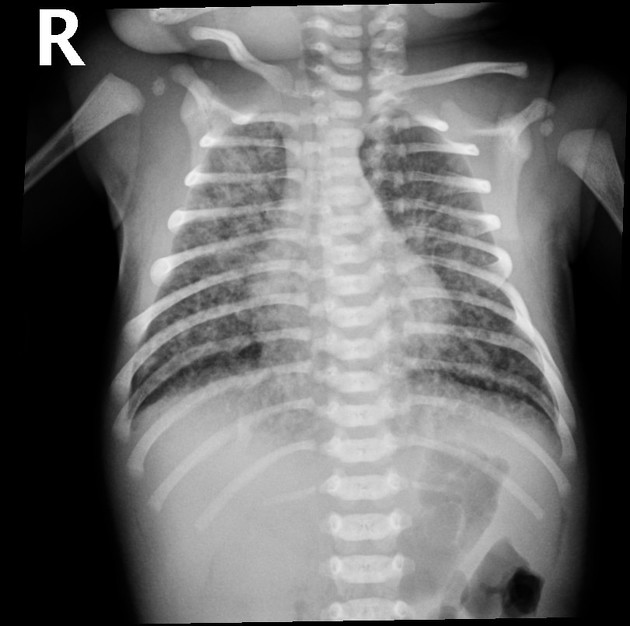
Classic appearances: patchy, asymmetric coarse ("ropey") opacities with areas of hyperinflation and atelectasis from air trapping. Look for air leak (pneumothorax, pneumomediastinum) and small pleural effusions; air bronchograms are usually absent. Radiographic severity may not match the clinical picture.
Case courtesy of Naim Qaqish, Radiopaedia.org. From the case rID: 74578. CC BY-NC-SA 3.0
MANAGEMENT
Largely supportive - gentle ventilation and strict avoidance of hypoxia, acidosis and agitation, which all worsen PPHN.
Delivery Room
- Routine oro/nasopharyngeal suctioning on the perineum is not recommended
- Routine intubation & tracheal suctioning of the non-vigorous infant is no longer recommended (ANZCOR/NRP) - prioritise effective ventilation
- Vigorous infant → routine care
- Non-vigorous infant → standard resuscitation with PPV; intubate/suction only if unable to ventilate
Supportive Care (mainstay)
- Admit to NICU/SCN; minimal handling, cluster cares - these infants are labile
- Target SpO₂ ~91-95%; avoid both hyperoxia and hypoxia
- Escalate support: O₂ → CPAP (caution: air-leak risk) → mechanical ventilation → HFOV in severe disease
- Maintain normal pH; avoid acidosis and agitation
- Thermoregulation, glucose, fluids; support BP/perfusion (inotropes to keep systemic > pulmonary pressure)
- Sedation ± analgesia to reduce agitation
Specific Therapies
- Surfactant - overcomes inactivation in severe MAS; may reduce ECMO need
- iNO - for PPHN with oxygenation failure (e.g. OI ≥20-25)
- Antibiotics - often started (e.g. ampicillin + gentamicin) as pneumonia cannot be excluded; stop if cultures negative
- ECMO - refractory respiratory failure; MAS has among the best ECMO survival rates
- Intercostal catheter for a significant pneumothorax
The rationale. Meconium doesn't only block airways - it chemically inactivates surfactant, and the inflammatory response injures the type II pneumocytes that make it, producing a secondary surfactant deficiency. That is the rationale that has been studied for giving exogenous surfactant (as a bolus down the ETT) in severe disease - to replace and overwhelm what the meconium has inactivated.
What the literature shows
- Early randomised trials in the 1990s (e.g. Findlay 1996; the Collaborative Surfactant Study Group) reported less severe respiratory illness and a reduced need for ECMO with bolus surfactant.
- A Cochrane review (CD002054) and a later 2016 systematic review & meta-analysis found a reduction in ECMO use and ventilation/hospital duration, but no clear effect on mortality.
- Surfactant lavage has been studied (including a 2020 updated meta-analysis), but the evidence is limited and low-quality, and it has not entered routine practice.
- Recent reviews (2024) conclude there is still no proven disease-specific therapy for MAS - care remains largely supportive, with surfactant, iNO and ECMO seen in severe disease.
- Newer and ongoing randomised trials (e.g. early bolus surfactant vs standard care) are re-examining timing and patient selection.
- Pre- and post-ductal SpO2 - watch for PPHN (labile or differential hypoxaemia).
- Minimal handling and a calm environment; over-stimulation can worsen PPHN.
- Maintain temperature, glucose and saturations; watch for pneumothorax.
- Escalate labile or worsening hypoxaemia early.
When would you escalate from CPAP to intubation in a hyperinflated MAS infant - and what makes you hesitate about CPAP?
How do you interpret pre- and post-ductal saturations at the bedside, and what does a >10% gap tell you?
What is your SpO₂ target, and why does hyperoxia matter in PPHN?
Why is routine tracheal suctioning of the non-vigorous infant no longer recommended?
Take-home message: MAS is a disease of term and post-term infants driven by airway obstruction, surfactant inactivation, inflammation and - most importantly - PPHN. Management is largely supportive: gentle ventilation with strict avoidance of hypoxia, acidosis and agitation, escalating to surfactant, iNO and ECMO in severe disease. Routine tracheal suctioning of the non-vigorous infant is no longer recommended.
For educational purposes only. Always align management to current ANZCOR/NRP guidelines and your local SCN/NICU or NETS protocols.