
RESPIRATORY CONDITIONS
Respiratory Distress Syndrome
A practical guide for paediatric registrars · Surfactant deficiency in the preterm newborn - previously known as hyaline membrane disease
DEFICIENCY IS THE
CORE DEFECT
Surfactant deficiency
Immature type II pneumocytes - surfactant appears ~24 weeks but is inadequate until ~34-36 weeks. The core defect.
Increased surface tension → atelectasis
Without surfactant, alveoli collapse at end-expiration; FRC falls and the lung becomes diffusely atelectatic.
↓ Compliance, V/Q mismatch
Stiff, poorly aerated lungs → shunting and hypoxaemia, CO₂ retention and markedly increased work of breathing.
Hyaline membrane formation
Ischaemic epithelial injury + protein-rich exudate line the alveoli/ducts - the histological hallmark (“hyaline membrane disease”).
Structural immaturity
Fewer alveoli, a compliant chest wall and weak respiratory muscles amplify the deficit.
CLINICAL FINDINGS
- Preterm infant, onset within minutes-hours of birth
- Tachypnoea and expiratory grunting (laryngeal braking to maintain FRC)
- Nasal flaring; intercostal, subcostal & sternal recession
- Cyanosis and rising oxygen requirement
- Reduced air entry, fine inspiratory crackles
- Progressive over 48-72h, then a diuretic phase with improvement
INVESTIGATIONS
- CXR: diffuse, bilateral, symmetrical fine reticulogranular (“ground-glass”) pattern, air bronchograms, low volumes; severe → “white-out”
- Blood gas: hypoxaemia, hypercapnia, respiratory ± metabolic acidosis
- Pre/post-ductal SpO₂, blood glucose, electrolytes
- Sepsis screen: FBC, CRP, blood culture (GBS pneumonia can mimic RDS exactly)
- Echocardiography if significant PDA or PPHN suspected
COMPLICATIONS & RED FLAGS
- Air leak: pneumothorax, pulmonary interstitial emphysema (PIE)
- Haemodynamically significant PDA
- Bronchopulmonary dysplasia / chronic lung disease
- Pulmonary haemorrhage; PPHN (less common than in MAS)
- Comorbidities of prematurity: IVH, NEC, ROP
- Watch: escalating FiO₂/support, sudden desaturation (?pneumothorax)
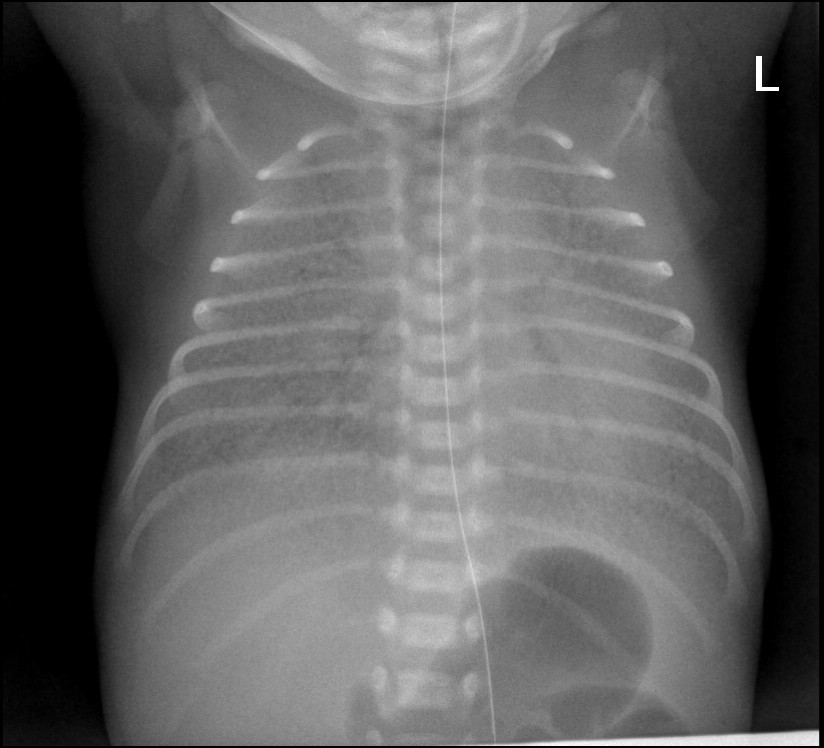
Classic appearances: diffuse, bilateral, symmetrical fine reticulogranular ("ground-glass") opacities with air bronchograms and low lung volumes (bell-shaped thorax); severe disease progresses to a "white-out". Surfactant and CPAP often alter the picture, so low volumes are not reliable in treated babies. A normal film at 6 hours of life effectively excludes RDS.
Case courtesy of Jeremy Jones, Radiopaedia.org. From the case rID: 56411. CC BY-NC-SA 3.0
MANAGEMENT
Prevent, support, replace - antenatal steroids, early non-invasive support and surfactant when needed, while protecting the lung.
Antenatal & Delivery Room
- Antenatal corticosteroids for threatened preterm birth (<34-35 weeks, and selected late-preterm) - reduce RDS, IVH, NEC & mortality
- Magnesium sulfate for neuroprotection where indicated
- Thermoregulation: plastic wrap/bag, warm room - hypothermia worsens surfactant function
- Delayed cord clamping
- Early CPAP for the spontaneously breathing preterm; blended O₂ titrated to SpO₂
Respiratory Support
- Non-invasive first line: CPAP (5-8 cmH₂O) - reduces ventilation and chronic lung disease
- Surfactant replacement: LISA/MIST (thin catheter on CPAP) increasingly preferred over INSURE; rescue dosing for established/worsening RDS
- NIPPV or mechanical ventilation if CPAP fails - volume-targeted, lung-protective, permissive hypercapnia; HFOV for severe disease
- Caffeine for apnoea and to support extubation
- Target SpO₂ ~90-94%; avoid hyperoxia (ROP, chronic lung disease) and hypoxia
Supportive Care
- Consider antibiotics, and if started continue until sepsis is excluded - RDS can be indistinguishable from GBS pneumonia
- Cautious fluids - overload worsens PDA and chronic lung disease
- Glucose, nutrition, maintain BP/perfusion, treat anaemia
- Identify and manage a haemodynamically significant PDA
- Minimal handling, cluster cares, ongoing thermoregulation
- CPAP care: prong/mask fit, nasal skin integrity and preventing nasal trauma; keep the airway clear.
- Monitor SpO2, work of breathing and gases; target saturations and avoid hyperoxia.
- Thermoregulation and clustered, minimal handling (developmental care).
- Watch for sudden deterioration (air leak); keep parents informed.
When would you choose LISA/MIST over INSURE for surfactant delivery, and which infants are unsuitable?
What is the evidence for early CPAP versus routine intubation in the very preterm infant?
How do antenatal corticosteroids change your expectations of the disease course?
What is your SpO₂ target, and how do you balance ROP/chronic lung disease risk against hypoxia?
Take-home message: RDS is a disease of prematurity caused by surfactant deficiency, leading to atelectasis, poor compliance and impaired gas exchange. Antenatal corticosteroids, early CPAP and surfactant replacement - increasingly via LISA/MIST - are the cornerstones, alongside lung-protective ventilation and careful oxygen targeting. Watch for air leak, a significant PDA and progression to chronic lung disease.
For educational purposes only. Always align management to current ANZCOR/NRP guidelines and your local SCN/NICU or NETS protocols.