
RESPIRATORY CONDITIONS
Transient Tachypnoea of the Newborn
A practical guide for paediatric registrars · Retained fetal lung fluid ("wet lung") in the newborn infant
BUT A DIAGNOSIS
OF EXCLUSION
Delayed lung fluid clearance
At birth, ENaC sodium channels (driven by labour, catecholamines and cortisol) switch the lung from secretion to absorption. Delay leaves fluid behind.
Pulmonary oedema
Retained interstitial and alveolar fluid reduces lung compliance.
Air trapping
Fluid in the airways causes partial obstruction and hyperinflation (flat diaphragms).
Mild V/Q mismatch
A widened diffusion distance gives mild hypoxaemia; the baby compensates with tachypnoea, and CO₂ stays normal or low.
Self-resolving
As clearance catches up over hours to days, the fluid reabsorbs and the distress settles.
CLINICAL FINDINGS
- Onset within the first 1-2 hours of life
- Tachypnoea is the dominant sign (often 60-120 breaths/min)
- Mild distress only: grunting, flaring, mild recession; cyanosis mild or absent
- Low or no oxygen requirement (often FiO₂ <40%)
- Barrel-shaped, hyperinflated chest with good air entry
- Otherwise well; distress plateaus and improves rather than progressively worsening
INVESTIGATIONS
- CXR ("wet lung"): hyperinflation, prominent perihilar streaking, fluid in the horizontal fissure, small effusions; clears within 24-48h
- Pre/post-ductal SpO₂ (usually normal)
- Blood gas if more distressed: mild hypoxaemia with normal or low CO₂ (acidosis points elsewhere)
- Blood glucose
- Sepsis screen (FBC, CRP, culture) - early pneumonia/sepsis is indistinguishable
- A diagnosis of exclusion - if it doesn't fit, look again
COMPLICATIONS & RED FLAGS
- Usually none - it is self-limiting
- Reconsider if distress worsens or persists, FiO₂ climbs above ~40%, or there is significant hypoxaemia
- Hypercapnia or acidosis is not TTN - think RDS, pneumonia/sepsis, pneumothorax, PPHN or cardiac
- Aspiration risk if fed while very tachypnoeic
- A prolonged course (>72h) warrants re-evaluation
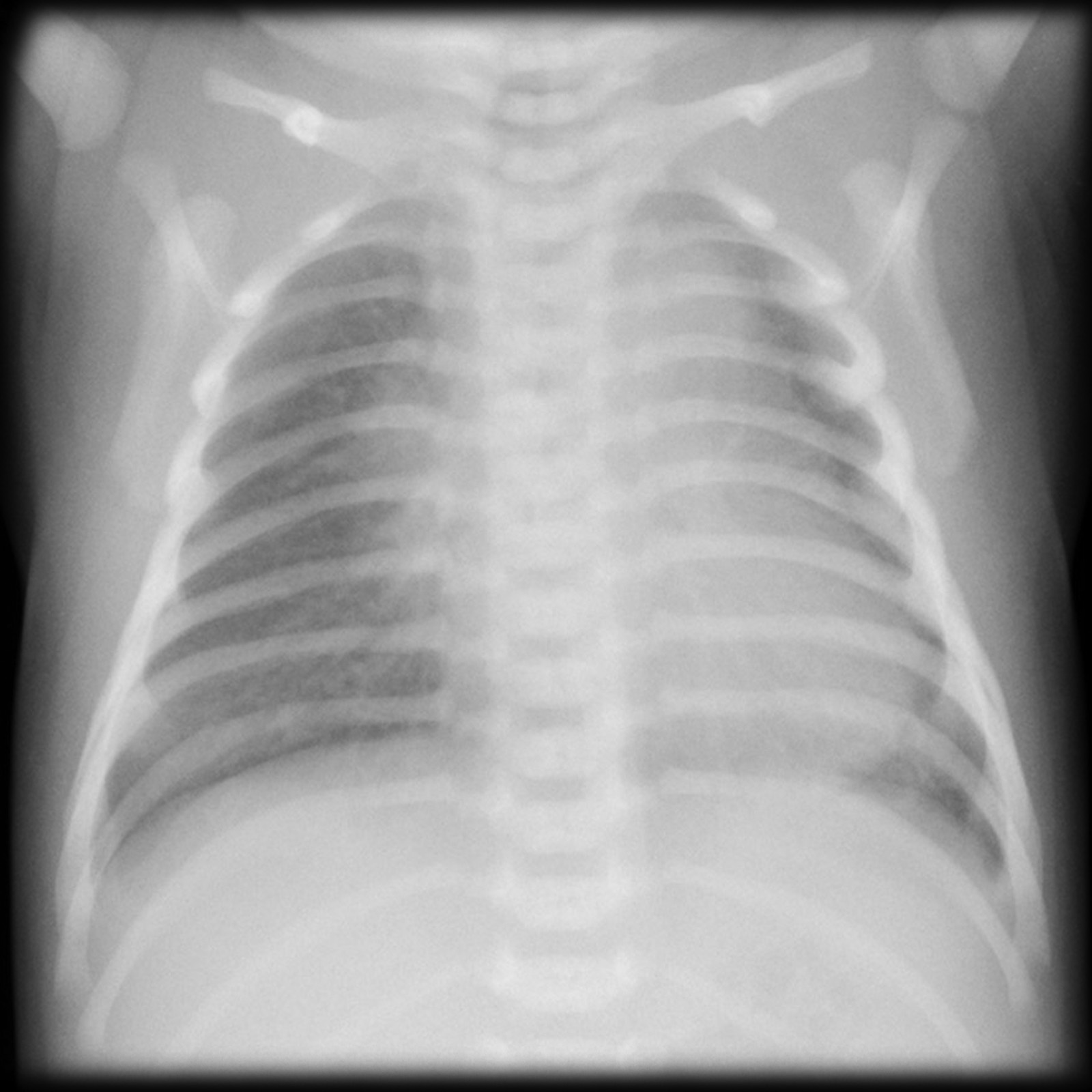
Classic appearances: hyperinflation, prominent perihilar streaking, fluid in the minor (horizontal) fissure, small laminar pleural effusions and indistinct "fuzzy" vessels. Heart size is normal, and the changes usually clear within 24-48h.
Case courtesy of Frank Gaillard, Radiopaedia.org. From the case rID: 8269. CC BY-NC-SA 3.0
MANAGEMENT
Supportive and watchful - most babies need little beyond observation, oxygen and feeding caution while it settles.
Supportive Care
- Admit for observation; minimal handling and thermoregulation
- Oxygen to maintain SpO₂ - most babies need little or none
- CPAP if increased work of breathing or higher oxygen needs - helps clear fluid and hold FRC
- Monitor respiratory rate, work of breathing and saturations
Feeding & Fluids
- If RR remains persistently elevated (>80), consider whether to withhold oral feeds and use IV fluids instead
- Enteral feeds once RR settles and the infant is stable
- Oral feeds / breastfeeding as tachypnoea resolves (no oral feeds while on CPAP)
Sepsis & Reassessment
- TTN mimics early sepsis/pneumonia - take a sepsis screen
- Consider empiric antibiotics if risk factors, unwell or atypical; stop at 36-48h if cultures are negative and improving
- Expect improvement within 24-72h; if not, reconsider the diagnosis and call NETS
- Not needed: surfactant, diuretics or routine salbutamol
- Watch respiratory rate, work of breathing and SpO2; it usually settles within 24-72h.
- Feeding caution if tachypnoeic (>60-80) - small paced feeds, and NG or IV fluids may be needed until it settles.
- Thermoregulation and clustered, minimal handling.
- Reassure parents it is usually self-limiting; escalate if it worsens or is slow to improve.
How do you tell TTN, RDS and early-onset pneumonia apart at the cot side in the first hours?
At what respiratory rate do you withhold feeds, and when do you resume?
Why is TTN a "diagnosis of exclusion," and what would make you abandon it?
What does the evidence actually say about diuretics and salbutamol in TTN?
Take-home message: TTN is the commonest cause of newborn respiratory distress - delayed clearance of fetal lung fluid causing tachypnoea that settles within 24-72h. Care is supportive: oxygen, sometimes CPAP, and feeding caution while tachypnoeic. Because it mimics RDS and early sepsis and is a diagnosis of exclusion, cover for infection when in doubt and think again if the baby is not improving.
For educational purposes only. Always align management to current ANZCOR/NRP guidelines and your local SCN/NICU or NETS protocols.